

Most UK private dental practices think their problem is missed calls. The bigger problem is the calls they do answer.
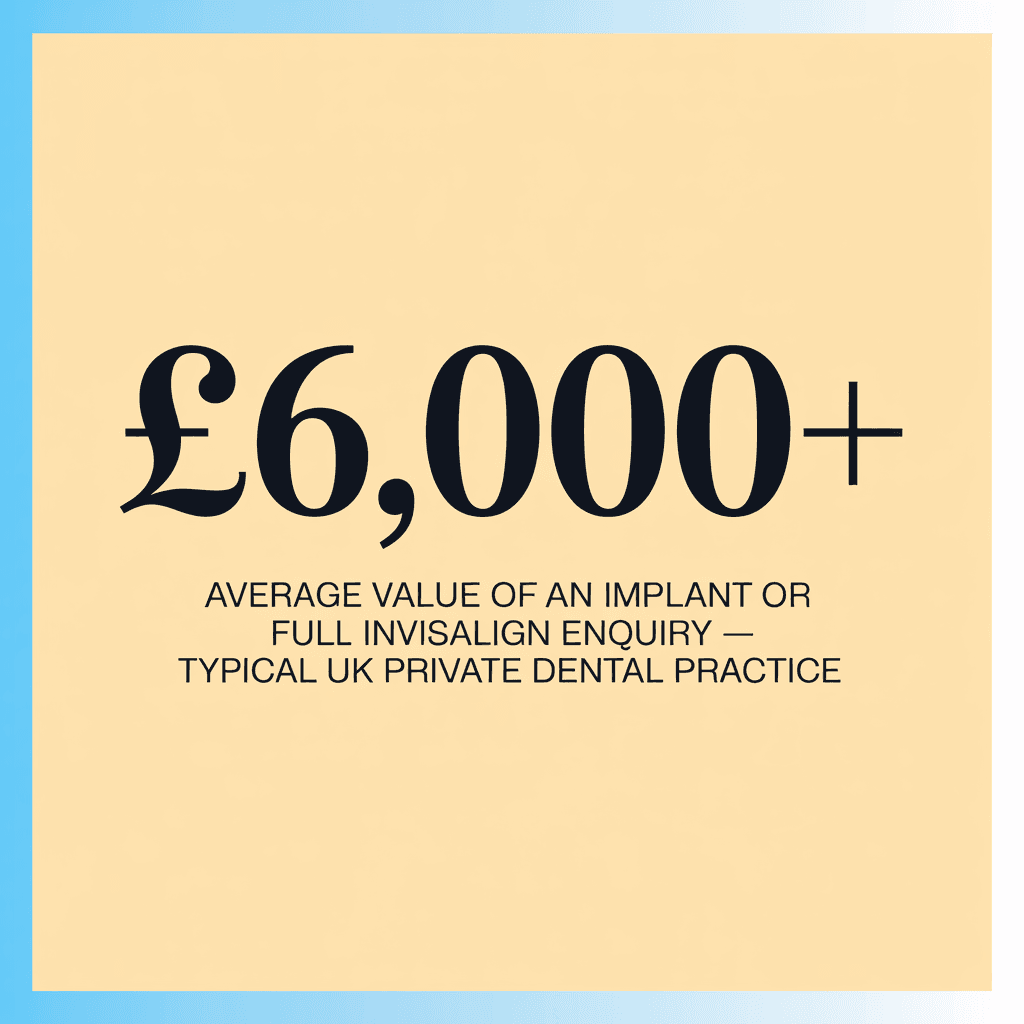
A practice can have a 95% answer rate and still lose most of its high-value treatment enquiries. The phone is picked up, the patient asks about an implant, and somewhere between hello and the booked consultation the conversation goes wrong. The enquiry never becomes a patient. The £6,000 walks away while the practice manager logs it in the diary as "rang for info."
This post is about that second leak. The one the missed-call audit does not see.
The shape of the leak
Take a UK private practice that answers 95 out of 100 inbound calls. Of those 95, roughly 30 to 40 are high-value treatment enquiries: implants, Invisalign, full-mouth restorative, large composite cases. The rest are existing patients, recalls, suppliers, and marketing calls.
Of those 30 to 40 high-value enquiries, the typical UK private practice converts somewhere between 18% and 32% into a paid first consultation. A few stand-out practices push 40%. The bottom quartile sits below 12%.
The maths is brutal. A 12% conversion rate on 35 weekly high-value enquiries at an average completed-case value of £6,000 is 4 patients per week, £24,000 a week, £1.2 million a year. The same volume at 28% conversion is £56,000 a week, £2.9 million a year. Same calls, same marketing spend, same practice. A different conversion rate is worth £1.7 million.
Most UK private practices do not know which of those two numbers they are. They know their gross. They do not know the spread between "patients who rang" and "patients who paid for a consultation."
That gap is the post.

The four moments where the enquiry leaks
A high-value enquiry call has four pivotal moments. Each one is a single decision point. Get all four right and the patient books. Fumble any one and the patient hangs up "to think about it" and never rings back.
Moment one: the first three seconds
The greeting. Most UK practices answer with the practice name, a friendly tone, and the receptionist's name. Most callers absorb roughly four words before deciding whether to keep talking.
The leak is not technical. It is energy. A receptionist on call six of the morning, answering between sterilising a tray and confirming a recall, sounds tired by the third ring. A high-value enquiry is the first call that patient has made about treatment they have been thinking about for months. They hear a tired voice. They feel like the inconvenient interruption they sound like. The script does not matter at this point. The energy in the first four words decides whether they keep going or hang up "to look into it more."
No long script. No fancy greeting. Just the energy. A practice with a manager juggling 60 jobs does not produce energy at moment one. That is the first hole.
Moment two: the qualification gap
The conversation gets past the greeting. The patient says they are interested in implants. The receptionist asks how they can help. The patient gives a one-line summary. Now the receptionist has 30 seconds to decide what kind of conversation this is.
A trained dental receptionist asks three or four targeted qualifying questions: how long has the tooth been missing, what have you tried, what is making you call now, what is your timeline. Each question buys both information and rapport. Each one tells the patient "this practice takes my situation seriously."
An untrained or under-resourced receptionist asks one question ("would you like to book a consultation?") and either gets a yes (the easy 18%) or a "let me think about it" (the lost 82%). The qualification gap is the difference between those two outcomes.
The fix is not personality. The fix is a structured qualifying flow the receptionist is confident in. Most UK private practices do not have one written down.
Moment three: the price moment
At some point the patient asks "how much." This is the most dangerous 20 seconds of the call.
A receptionist who quotes a single number kills the consultation. The patient hears the number, says "ok let me think about it," and is gone. A receptionist who says "we cannot give a price without seeing you" sounds evasive. The patient hears the dodge, says "ok let me think about it," and is gone.
The fix is a range plus a reason. "Implant cases at this practice typically run between £3,000 and £4,500 depending on whether you need a bone graft, which we can only assess at the first consultation. The consultation itself is £85 and refundable against treatment if you proceed." That sentence answers the question, frames the next step, and gives the consultation a price the patient is comfortable saying yes to.
The exact words can change. The structure cannot. Range, reason, next step, price of next step. Without that structure the price moment kills more enquiries than missed calls do.
Moment four: the booking close
The patient has been qualified, has heard a price range, is interested. The receptionist asks when they would like to come in. The patient gives a vague answer ("next week sometime"). The receptionist offers one option. The patient says they need to check. The call ends without a booking and the receptionist promises to ring back.
That callback does not happen often enough. And the second time the patient picks up the phone they are usually less ready than the first time.
The fix is offering two specific slots and asking which works better. "I have Tuesday at 2 pm or Thursday at 10 am, which suits you?" Two anchors. One question. A binary choice the patient can answer right now.
What this actually costs
The four moments compound. A practice with a tired greeting, no qualifying flow, an evasive price answer, and a soft close converts 8% to 12% of high-value enquiries. The same practice with all four fixed converts 28% to 38%.
For a practice fielding 30 high-value enquiries a week at £6,000 average completed-case value:
| Conversion rate | Weekly patients | Weekly revenue | Annual revenue |
|---|---|---|---|
| 10% | 3 | £18,000 | £936,000 |
| 18% | 5.4 | £32,400 | £1.68M |
| 28% | 8.4 | £50,400 | £2.62M |
| 38% | 11.4 | £68,400 | £3.55M |
The difference between the bottom row and the top row is £2.6 million of completed treatment a year on the same call volume.
This is not a marketing problem. The marketing already worked. The patient already rang.

Why most practices cannot fix this with training alone
The natural reaction reading the four moments is to train the front desk team harder. Send them on a phone-handling course. Role-play the qualifying flow. Buy a script.
This works for a fortnight. Then peak season hits, the manager covers another role, a new starter joins, and the script drifts. Three months later the practice is back where it started.
The structural problem is that the four moments demand consistency under pressure. A human receptionist juggling sterilisation, clinic support, and a busy diary cannot deliver consistent qualifying flow for every enquiry call. They deliver it for some. The ones they deliver it for convert. The ones they do not deliver it for, do not.
The fix that holds is structural, not motivational. Either the practice resources the front desk so heavily that consistency is achievable (expensive, hard to recruit, turnover destroys it) or it removes the bottleneck so the same flow runs on every enquiry regardless of who picks up. The second option is what most premium UK private practices in 2026 are quietly moving toward.
For the broader 2027 adoption picture, see 78% of UK private dental practices use AI. For the missed-call side of the leak the four moments do not cover, see what a missed call costs a UK private dental practice.
Where to look first at your practice
You do not need a consulting engagement. You need three weeks and one metric.
Week one: measure. Pull every inbound call that ran longer than 90 seconds and shorter than 8 minutes (the high-value enquiry window). Count how many ended in a booked first consultation. That is your high-value conversion rate.
Week two: listen. Pick five recorded enquiry calls that did not convert. Listen with the four moments in mind. You will know within five minutes which moment your practice is leaking on. It is almost always one specific moment, not all four.
Week three: pick the fix. If the leak is moment one (energy), the fix is reducing the manager's mid-call workload. If moment two (qualification), it is a structured flow written down and rehearsed. If moment three (price), it is the range-plus-reason script. If moment four (close), it is two-slot offers with binary asks.
No deck. No consultant. No catalogue of options. Three weeks, one metric, one fix. The conversion number tells you whether it worked by week four. The patient revenue tells you by week eight.
For the cluster siblings on specific treatment angles, see dental implant consultation enquiry handling, Invisalign enquiry to first consultation conversion, and speed-to-respond at a UK private dental practice.
The number that matters
One number tells you whether your practice is on the right side of the £1.7 million conversion gap. Not your missed-call rate. Not your marketing spend. Not your Google rank. It is high-value enquiries divided by booked first consultations from those enquiries. If you do not know it, you cannot fix it. If you do, the four moments above tell you where to start.