
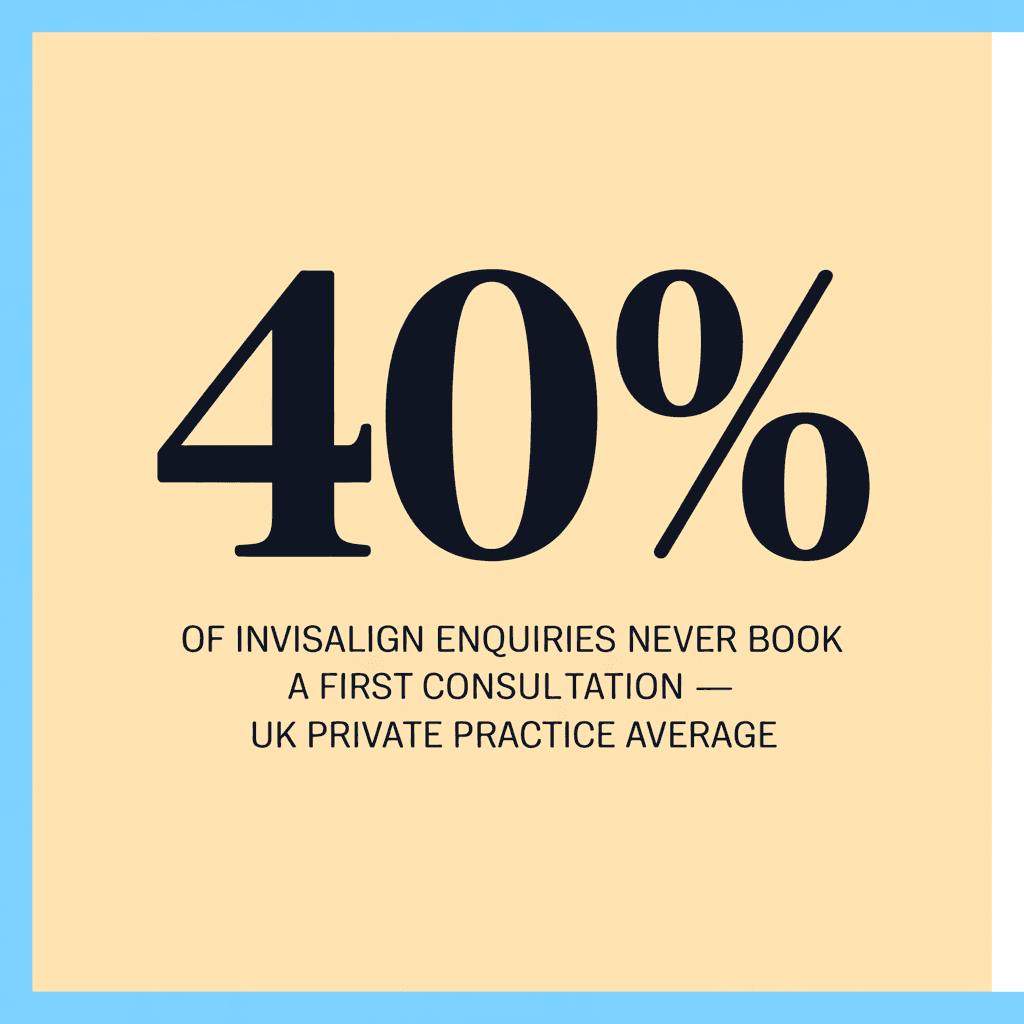
Roughly 40% of Invisalign enquiries to UK private dental practices never book a first consultation. The patient rings, has the conversation, says they will think about it, and never comes back. The Invisalign enquiry conversion uk practices report sits between 38% and 62%, depending on whether you measure best in class or median.
The leak is not random. It clusters at four predictable points in the call. Each one has a fix. Each fix is implementable in one afternoon. None of them require buying anything.
This post is about those four leak points and what to do at each. Treatment-specific to clear aligners, written for the principal or manager who already knows their conversion is below where it should be and wants to know exactly where to look.
Why Invisalign enquiries leak differently from implants
Invisalign enquiries do not behave like implant enquiries. The patient is younger on average, often researching online before they ring, and has usually compared at least two practices before picking up the phone. They are also less committed to clear aligners than they are to "fixing their teeth", which means a clumsy call easily redirects them to fixed braces, a different practice, or the doing-nothing option.
The implication: an Invisalign enquiry call is more competitive at the point of contact. The patient has options. The receptionist has roughly 90 seconds to convert curiosity into a booked consultation before the patient quietly drifts to whatever the next Google search throws up.
Four moments where they drift. Four fixes. In order.
Drop-out 1: the patient mentions a competing quote
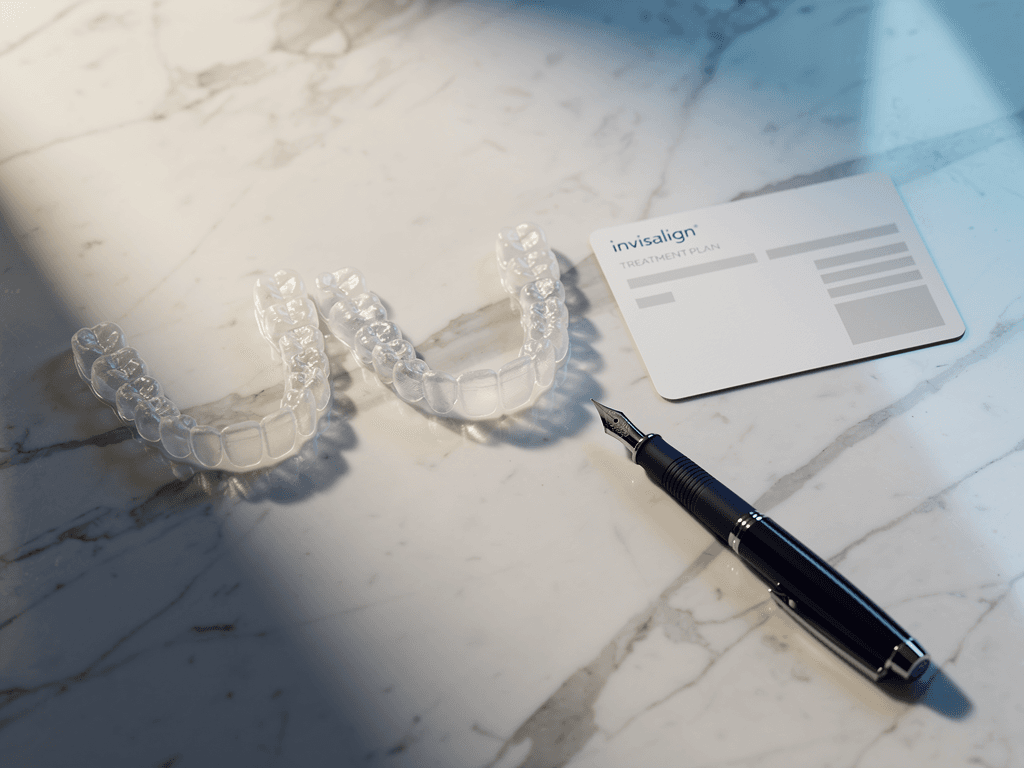
The first thing many Invisalign enquiry callers do, three sentences in, is mention a number they were quoted somewhere else. "I had a consultation last month and they said it would be £3,800. Just wanted to see what you would charge."
Most UK practice receptionists do one of two wrong things. Either they quote a lower number on the spot to compete (which destroys margin and signals price-only positioning), or they hedge and say they cannot give a number without seeing the patient (which sounds evasive against the practice that already quoted).
The fix is acknowledgement plus reframe. "Most Invisalign cases at this practice run between £3,200 and £4,800 depending on case complexity. The difference between practices on a similar price range usually comes down to how the case is planned. Could I ask what was included in the £3,800 quote. Was that the full case fee including refinements, retainers, and reviews?"
That sentence does three things: it gives a price range without underbidding, it reframes the comparison from price to plan, and it asks a question the patient probably cannot answer. The patient now realises they did not actually compare like for like. They are no longer shopping on price alone. The call continues.
Done well, this single fix recovers roughly 12% of Invisalign enquiries that would otherwise drift to the cheaper quote. The script can vary. The structure cannot: acknowledge, reframe, ask.
Drop-out 2: the patient asks about treatment time
Somewhere in minute two the patient asks how long Invisalign takes. Most receptionists give a flat answer ("usually 6 to 18 months"). The patient hears 18 months, decides that is longer than they wanted, and quietly disengages.
The fix is a range tied to case type, not to vague averages. "For minor crowding cases like the ones we see most, treatment is typically 6 to 9 months. For moderate cases involving the bite, it usually runs 9 to 14 months. The longer cases tend to be full-arch realignments where we are correcting both rotation and spacing. The first consultation tells us which type of case yours is, which then tells us the time."
That sentence anchors on the shorter end (most cases are shorter), reframes the longer numbers as specific case types rather than generic length, and ties the precise answer to the consultation. The patient hears "6 to 9 months" first, which is the number that sticks. They continue the conversation.
A practice that quotes flat "6 to 18 months" loses about 15% more enquiries at this point than a practice that quotes case-typed ranges. The math is straightforward: most callers will not need the 18-month cases. Quoting it as if they will, scares them off before the consultation can sort the case type.
Drop-out 3: the receptionist does not name what makes this practice different
By minute three the patient has had price and timeline. They have not been told anything specific about why they should book with this practice rather than the one down the road that quoted £3,800.
Most UK practice receptionists do not have a clear three-sentence answer to "what is different about this practice for Invisalign?" They mention free initial scans, or the experience of the principal, but they do not anchor on something specific the patient could not get elsewhere.
The fix is one named clinician plus one specific differentiator plus one outcome the patient cares about. "Dr Khan is an Invisalign Platinum provider, has completed over 600 cases, and personally plans every case using the digital outcome simulator so you see the predicted result on your own teeth before you commit. Most patients book on the back of seeing that simulation rather than on the price."
Three facts. Twenty-five seconds. Now the patient has something concrete to think about when they come off the phone. They are also significantly less likely to drift to the cheaper quote, because they have heard a reason this practice is not interchangeable with that one.
The fact set varies by practice. The structure does not: named clinician, specific differentiator, outcome the patient cares about. Most receptionists improvise this section, which means they skip it under pressure.
Drop-out 4: the close that is not actually a close
The patient has been qualified, has heard the price range, has heard the timeline range, has heard the differentiator. The receptionist asks "would you like me to book you in for a consultation?"
This is where the largest single drop-out happens. The patient says they need to discuss with their partner, look at the finances, or check their calendar. The receptionist agrees, says she will email information across, and ends the call.
The information email does not convert. The patient is gone.
The fix is a 48-hour callback booked into the diary at the end of the original call. "Let me send you the information now. Can I ring you back on Thursday at 6 pm to answer any questions and see if you would like to book in?" The 48-hour window is the discipline. The diary slot is the enforcement. The patient agrees because the ask is small and specific.
When Thursday at 6 pm arrives, the receptionist actually rings. The patient picks up because the call is expected. The conversion rate on this booked-callback path runs roughly 22% versus roughly 4% for the same warm patient on an email-only follow-up.
No script change. No price change. Just a diary slot booked at the end of the original call and the discipline to ring at the time agreed.
What this is worth
A typical UK private practice fielding 12 Invisalign enquiries a week at a 40% no-book rate loses 4.8 enquiries weekly. At a £3,800 average case value, those are roughly £18,000 of cases not booked per week, £936,000 per year.
Closing the four drop-outs above does not get the no-book rate to zero. It typically drops it from 40% to 18% to 22%. On the same call volume that is roughly 2.5 to 3 extra Invisalign cases booked per week, £475,000 to £570,000 of completed treatment recovered per year.
Same marketing spend. Same call volume. Different conversion path.
The order to fix in
If you can only fix one of the four this month, fix drop-out 4 (the booked 48-hour callback). It is the highest single recovery rate, requires no script change, and is enforceable through the practice management software.
Then move to drop-out 3 (the differentiator). Write the three-sentence answer down. Print it. Have every receptionist read it before any Invisalign call. Measure the booking rate against the week before.
Then drop-out 2 (the case-typed time ranges). Then drop-out 1 (the competing quote response).
Four fixes, four months, one moved every fortnight. The conversion rate is the only metric that matters. It tells you whether the fix is sticking before the revenue number does.
For the broader cluster pattern across all high-value treatment enquiries, see the pillar: why UK private dental practices lose £6,000 treatment enquiries. For the implant-specific equivalent, see dental implant consultation enquiry handling. For the cross-cutting speed issue under-girding all four drop-outs, see speed-to-respond at a UK private dental practice.