
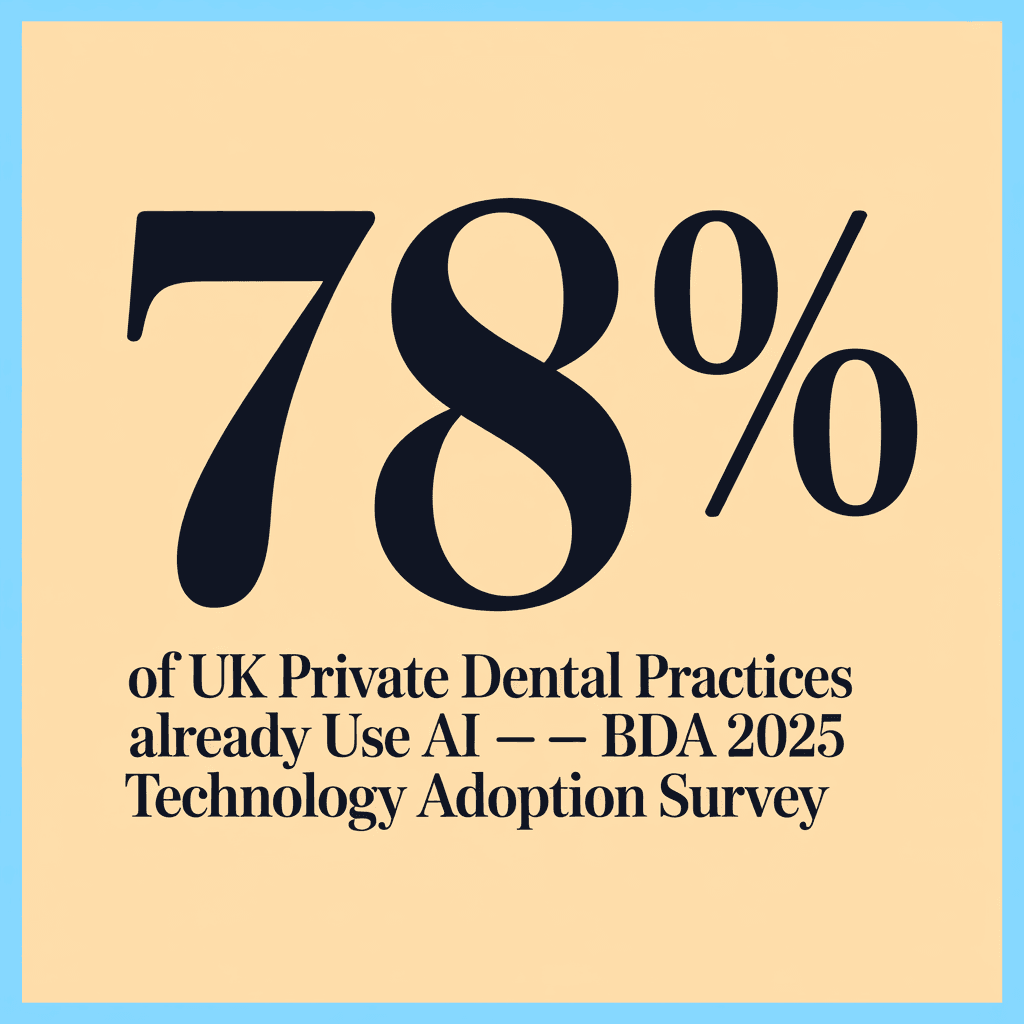
Three years ago, 23% of dental practices used any form of AI. Today the number is 78%. By 2027, 73% of the practices not using it yet plan to start. That leaves a shrinking group of practices on the wrong side of a deadline most of them do not know exists.
This is for that group.
If you run a private practice in the UK and have not yet decided where AI fits in, you have roughly 12 to 18 months before "we do not use AI" becomes the same kind of statement as "we do not use a computer." Patients will not see it that way. Associates joining the practice will not see it that way. The practice across the high street will not be waiting.
The work is already mapped. You do not need to figure out where to start from scratch. You need to know what the 78% are doing, where it is paying back, and which of the four use cases below fits your practice first.
Where the 78% number comes from
The British Dental Association's 2025 Technology Adoption Survey, summarised in TechRound's UK dentistry AI feature, found 78% of dental practices using at least one AI tool. The same survey put adoption at 23% in 2022.
A separate piece in the Brit Asia Doctors 2025 landscape report found 73% of dental practices planning to adopt AI by 2027. And an academic survey published in PMC found 87% of dental professionals expect AI to be a standard part of future practice operations.
Three different sources. Three different methodologies. Same direction.
That is the deadline. The question is not whether your practice adopts AI. The question is which use case you pick first.

The four places AI is actually working in private dental
The 78% are not all using the same thing. Adoption is concentrated in four areas, each with very different payback profiles.
1. Radiograph reading and clinical decision support
The clinical use case the press writes about. AI image-analysis tools flag caries, periapical pathology, bone loss, and root fractures on intraoral and panoramic radiographs, then surface them to the clinician for review. Best-known tools in the UK market: Pearl, Overjet, Diagnocat.
Where it pays back: treatment plan defensibility, second opinions, patient trust during case presentation. A clinician explaining a plan with a marked-up radiograph closes more high-value treatment than one explaining it with words.
Where it does not: raw chair-time savings. The clinician still reads the radiograph. The AI is a check, not a replacement.
2. Automated recall and reactivation
The least talked about, the highest ROI. Recall systems built on top of Dentally, SOE, or R4 identify patients overdue for hygiene, examination, or treatment plan completion, and run automated SMS and email sequences to bring them back. Some now layer AI on top to choose the channel, time, and message per patient.
Where it pays back: a single recovered hygiene patient at £85 covers six months of most recall tools. A reactivated lapsed patient with a £2,400 treatment plan covers them for two years. Practices report 8% to 15% list reactivation in the first 90 days.
Where it does not: practices with messy patient databases. The tool surfaces the problem. It does not fix the data.
3. Front-desk call handling
The use case that catches most practices off guard. UK practices average somewhere between 22% and 45% missed inbound calls depending on the day, the season, and whether the practice manager is in clinic supporting the dentist. Hiya's research shows 80% of callers sent to voicemail never leave a message. For a new-patient enquiry to a private practice, that is roughly £2,300 to £4,800 of lost lifetime value per call, depending on your case mix.
An AI voice receptionist answers the phone in under three seconds. Books the appointment. Logs the patient. Sends the confirmation. Covers lunch, after hours, weekends, and the days the manager is helping with sterilisation.
Where it pays back: any practice losing more than 15 calls a week. Most practices have no idea what their actual missed-call rate is until they measure it. (See: what a missed call costs a private dental practice.)
Where it does not: complex clinical conversations, complaints, treatment plan negotiations. The practice manager still handles those.
4. Treatment plan drafting and patient communication
The newest entry. Clinical note-takers like Heidi and Dentr now draft post-appointment patient summaries, treatment plan letters, referral letters, and follow-up communication from chairside dictation. The clinician dictates the plan in 90 seconds. The AI writes the 800-word patient-facing letter in 30.
Where it pays back: the 45 minutes per day a principal dentist spends writing letters and notes. Across a 200-day clinical year, that is 150 hours back to the diary or to the family.
Where it does not: practices without consistent dictation habits. The tool only works if the clinician actually dictates.
What the 22% have in common
Three years of close conversations with private practice owners. The 22% who have not adopted AI yet tend to share three things.
One: they do not know what they do not know. Most assume "AI in dentistry" means radiograph reading and treatment planning. They do not realise the highest-ROI use cases (recall, front-desk cover) are not clinical at all. They are front-office.
Two: they tried one tool, it did not stick. Often the wrong tool for their practice. A solo NHS-mix practice does not need a chairside AI scribe. A boutique private practice with a single dentist and a part-time manager needs front-desk cover before it needs treatment plan drafting.
Three: they overestimate setup difficulty. The recall and front-desk tools that work in 2026 install in under a fortnight, integrate with Dentally, SOE, R4, and Carestream out of the box, and do not require any clinical workflow changes.
None of those three are real reasons to wait. They are reasons people happen to give.
The 2027 timeline, working backwards
Two years sounds like a long time. It is not.
- Now to month 3: decide which of the four use cases applies first. This is the only decision that matters in 2026. Get it wrong and you waste 90 days on the wrong tool.
- Month 3 to month 6: install, integrate, train the team. Recall and front-desk tools deploy fastest. Clinical tools take longer because they need workflow change.
- Month 6 to month 12: measure. Recall reactivation rate. Missed-call rate before and after. New-patient enquiry-to-booking conversion. The numbers that matter.
- Month 12 to month 24: layer the second use case. By 2027 most private practices that adopt early will be running two or three AI systems in parallel.
The 22% who start in 2026 are still the early movers. The 22% who start in 2027 are not.
Where to start: the one question that decides it
Forget the tool catalogues. The decision is one question.
What is the single biggest leak in your practice right now: clinical time, recall rate, or missed calls?
If clinical time: start with the radiograph tools or the chairside scribe.
If recall rate: start with automated reactivation.
If missed calls: start with an AI voice receptionist. (See: AI receptionist vs dental practice manager.)
Pick the leak that costs you the most this month. Fix that one. Come back to the others. Practices that pick the right first use case keep using AI. Practices that pick the wrong one stop.
No catalogue. No demo gauntlet. No proof-of-concept paralysis. One leak, one tool, one fortnight.
Six examples of what this actually looks like
If you want concrete: how private dental practices are actually using AI in 2026 walks through six real implementations, what each costs, and what each returns in the first 90 days.
What this means for the next 90 days at your practice
You do not need a strategy document. You do not need a vendor selection committee. You do not need a digital transformation consultant. You need 90 days to do three things.
Week one: measure. Pull your missed-call report for the last 14 days. Pull your active patient list and count how many have not had a hygiene or check-up appointment in the past 18 months. Ask your principal dentist how many minutes per day they spend writing patient letters. Three numbers. One afternoon.
Week two: pick the leak that costs the most. Apply the £2,300 average new-patient lifetime value to your missed-call count. Apply the £85 hygiene appointment value to your lapsed patient count. Apply the principal's hourly rate to the letter-writing time. One of the three numbers will dwarf the other two. That is your starting use case.
Weeks three to six: choose one tool. Read the vendor's UK case studies. Insist on talking to two reference practices, both UK private. Ask them what they would change if they were starting again. Pick the tool. Sign for three months, not twelve.
Weeks seven to twelve: install, train the team, measure again. The same three numbers. If the chosen tool moved the number, you have your first AI deployment. If it did not, you have learned more about your practice than any vendor demo could teach you.
By month four you either have a second use case lined up or you have hard evidence the first one is not pulling its weight. Either is a result. Standing still is not.