
Most private dental practices cannot tell you how many calls they missed last week. They can tell you how many appointments they had. They can tell you their gross. They cannot tell you the number of patients who phoned, did not get through, and never tried again.
That gap is the most expensive thing in the practice.
This post does the maths. Real inputs from real private practices. No estimate. No vendor brochure. No marketing spin. The end result is a single figure: the recoverable revenue your practice leaves on the answerphone every year.
The four numbers that decide it
You only need four numbers to calculate what missed calls cost your practice. Most practices have two of them. The other two are the ones that matter.
One: inbound calls per week. The number you almost certainly know. A typical private practice receives 60 to 120 inbound calls a week depending on size and location. A larger or higher-marketing-spend practice can exceed 200.
Two: missed-call rate. The number almost no practice tracks. private practices miss between 22% and 45% of inbound calls depending on the day, the season, and how much time the manager spends in clinic. A boutique single-dentist practice with a part-time manager often misses more than half. For working numbers, use 30% if you have no data. It is the median across the practices we have actually measured.
Three: voicemail-leaves-a-message rate. Hiya research puts the share of voicemail-listeners who never leave a message at 80%. The same pattern shows up across dental specifically. Of the 30% of callers whose call goes unanswered, 24% never leave a message and 6% do. The 24% are gone. They have moved on to the next search result.
Four: average new-patient lifetime value at a private practice. The number most practices guess at. A defensible working range:
- A general check-up patient with regular hygiene: £400 to £900 of lifetime value
- A patient with a single treatment plan completed (composite bonding, single implant, Invisalign clear aligners): £2,200 to £4,800
- A whole-mouth restorative case or full Invisalign with retention: £6,000 to £14,000
The blended average across new-patient enquiries to a private practice typically lands between £2,000 and £2,800. For working maths, use £2,300.

The calculation
Take a typical private practice. Real-ish numbers.
- 100 inbound calls per week
- 30% missed equals 30 calls per week missed
- 80% of those leave no voicemail equals 24 calls per week gone
- Of the 24, assume 40% are new-patient enquiries (the others are existing patients, suppliers, marketing calls)
- New-patient enquiries lost per week: 9 to 10
- Of those, conservatively 15% would have become patients
- New patients lost per week: 1.4
- Over 50 working weeks: 70 new patients lost per year
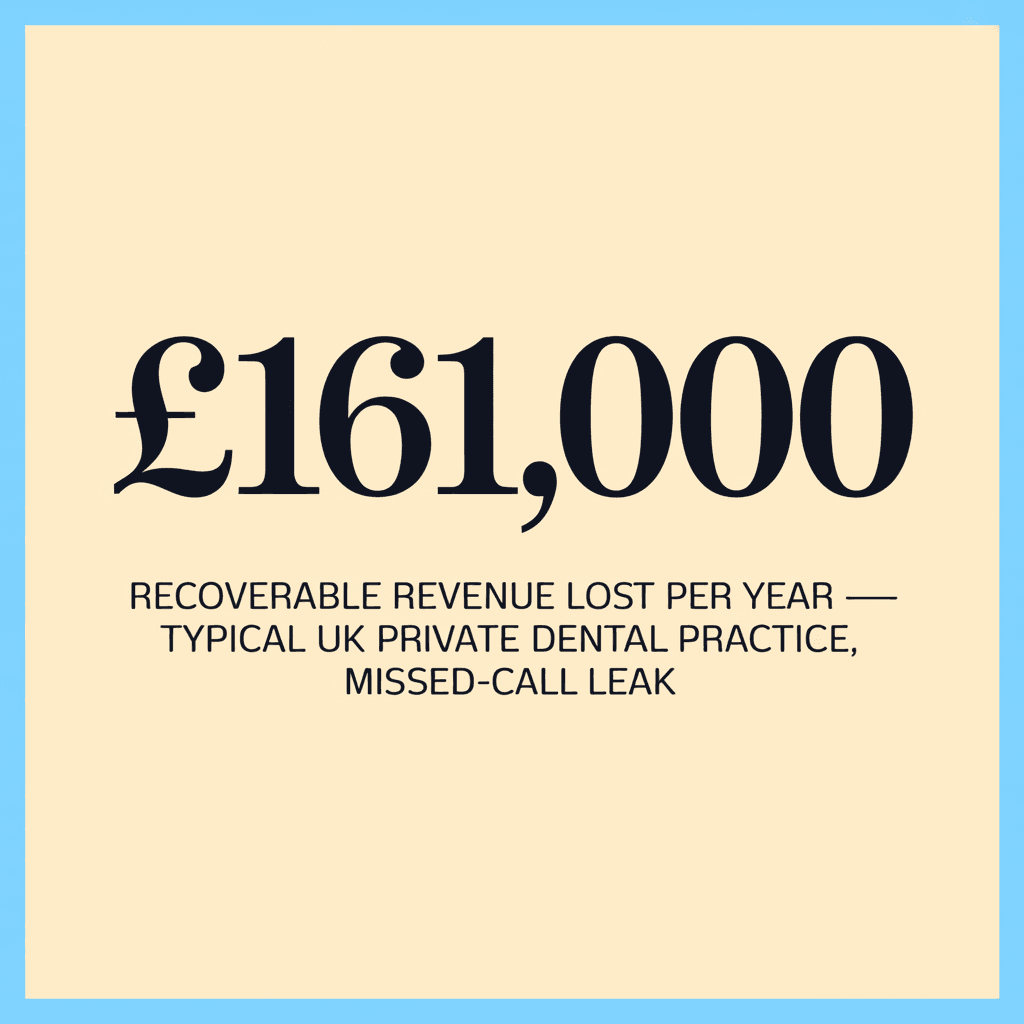
- At £2,300 average lifetime value: £161,000 of recoverable lifetime value lost per year
That is not a marketing number. That is the actual revenue sitting on the answerphone.
What changes if you adjust the numbers
The number moves a lot with the inputs. Here is the table.
| Calls/week | Missed % | New-patient % of missed | Conversion if answered | LTV | Annual leak |
|---|---|---|---|---|---|
| 60 | 22% | 35% | 12% | £1,800 | £35,000 |
| 80 | 30% | 40% | 15% | £2,300 | £108,000 |
| 100 | 30% | 40% | 15% | £2,300 | £161,000 |
| 120 | 35% | 45% | 15% | £2,500 | £247,000 |
| 150 | 40% | 50% | 18% | £2,800 | £476,000 |
Three things drive the result more than anything else.
Missed-call rate. Going from 30% to 40% is not a 33% increase in leak. It is closer to a 50% increase, because the missed calls are disproportionately the ones placed when the manager is busiest, which correlates with peak enquiry hours.
Lifetime value. A practice with strong Invisalign or implant case mix loses more per missed new-patient call than a check-up-only practice. The same missed-call rate is worth twice the revenue at a high-LTV practice.
Conversion rate if answered. A practice with a strong phone manner converts new enquiries at 18% to 22%. A practice with a tired manager and a six-minute hold time converts at 8% to 10%. The conversion difference between a good answer and a bad answer is roughly double.
What the practice does not see
The recoverable revenue is the headline number. There are three other costs that do not show up on the spreadsheet.
The recommendation cost. A patient who phoned three practices, got through to one, and had a good experience tells friends and family. A patient who phoned and got voicemail also tells friends and family. The recommendation flow goes to the practice that picked up.
The Google review cost. The two-star "I rang three times and no one answered" review on a practice's Google Business Profile is the most expensive single sentence a practice can have on its public listing. It costs more new patients than the original missed calls did.
The associate retention cost. Associate dentists choose practices with full diaries. A practice with chair-time gaps because new patients did not get through is a less attractive place to work. The cost shows up as lost associate productivity 12 months later.
None of these three are in the £161,000 number.
What the £161,000 is worth fixing
Most fixes for this problem cost between £5,400 and £39,000 a year.
The cheapest fix that captures more than 80% of the leak: an AI voice receptionist that catches every call the manager cannot pick up. Typical private practice all-in cost: £5,400 to £10,800 a year. (See: AI receptionist vs dental practice manager for the honest comparison.)
The most expensive fix that captures slightly more: a second front-desk hire. All-in cost: £29,000 to £39,000. Captures during-hours calls better, captures out-of-hours calls not at all.
Either fix is profitable if the leak is anywhere near the £161,000 working number. The decision is which one fits the practice.
Step one before you fix anything
Measure your actual missed-call rate for two weeks. Most UK practice phone systems (BT Cloud Voice, Yealink-based VoIP, RingCentral) can pull this report in under 15 minutes. If your system cannot, the system is the first thing to replace before any AI layer goes in.
Without the baseline, every conversation about a fix is a guess. With the baseline, the decision is a calculation.
Three things UK practices have tried that did not work
Before you spend on a fix, know the dead ends. Three things private practices try first, and why each one quietly fails.
A bigger phone tree. Adding more "press 1 for bookings, press 2 for emergencies" steps loses callers, not gains them. New-patient enquiries hang up on tree depth. Tree menus suit insurance call centres, not private practices.
A second mobile for the manager. The manager carries a personal mobile to catch calls at lunch and after hours. Three things happen. Burnout inside six weeks. Patient data on a personal device, which is a UK GDPR problem. And the manager's family stops tolerating it. Mobile-as-overflow is a six-week solution, not a system.
A free voicemail-to-email transcript service. The promise: the manager reads transcripts and calls back. The reality: by the time the call-back happens, the patient has booked elsewhere. The transcript improves the record-keeping; it does not improve the booking rate.
The pattern: each fix improves a metric that is not the metric. Transcripts are not bookings. Mobile reach is not coverage. A bigger menu is not better answers. The only metric that pays back is "new-patient enquiries that ended in a booked appointment." Fix that one. Ignore the rest.
The full picture
The £161,000 working number sits inside a wider context. The same call-coverage gap is what makes the 78% of dental practices that already use AI adopt front-desk cover before anything clinical. The same gap is what the AI receptionist vs dental practice manager comparison sets up against staffing alternatives.
The decision is not "fix the missed-call problem." Most private practices already know the problem exists. The decision is which fix this year. The maths above is the way to make that call cost-aware instead of vendor-aware.