
A new patient rings your UK private dental practice asking about an Invisalign consultation. They reach the answering machine. You ring back five hours later. The patient has booked elsewhere. Five hours is not late by accident. It is the median dental enquiry response time uk practices actually deliver, across every system that does not answer in real time.
The cost of those five hours is bigger than the cost of missing the call entirely.
This post is about why a 5-minute response converts roughly 100 times better than a 5-hour response on a UK private dental enquiry, what the conversion curve actually looks like, and the structural fix any practice can ship in a fortnight.
The 100x stat is real
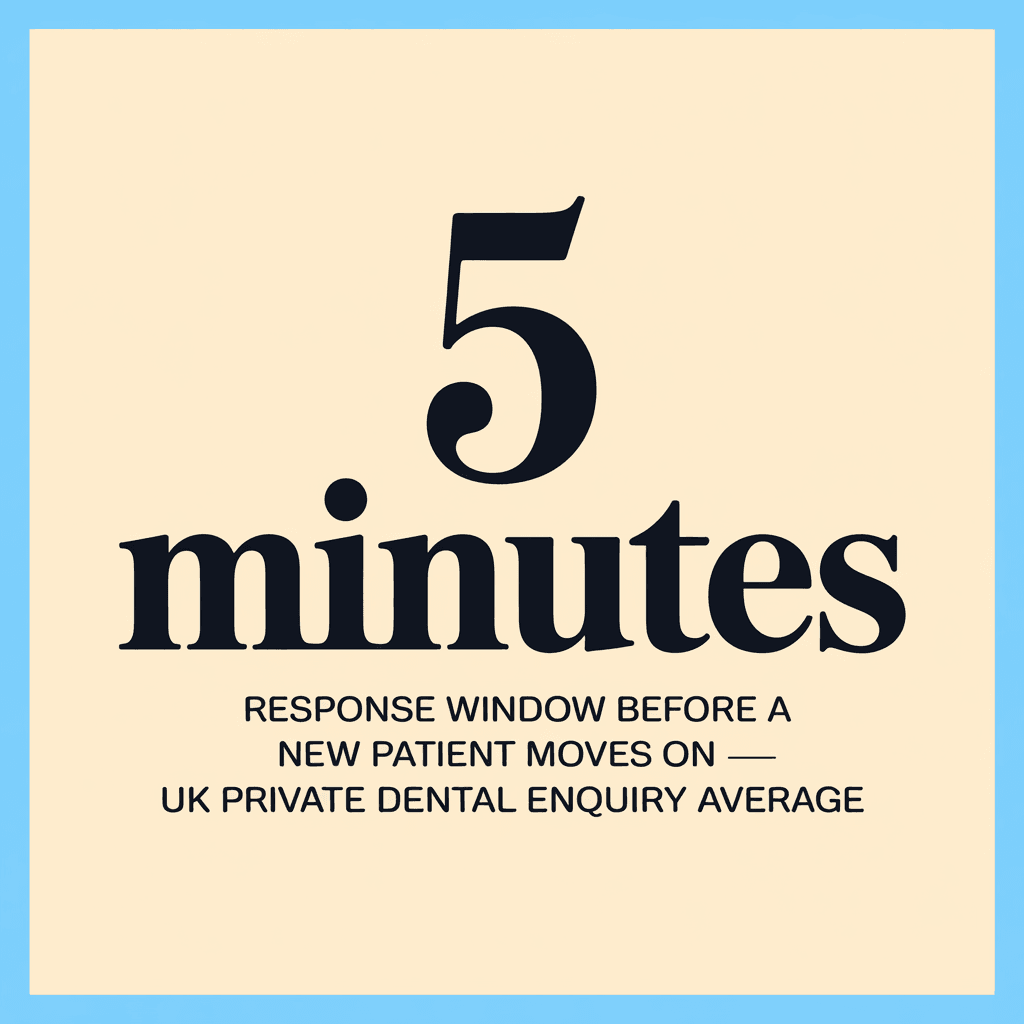
The research most often cited is the Harvard Business Review 2011 study by Oldroyd, McElheran, and Elkington, which measured response time against contact-and-qualify rate for over 2,000 US businesses across multiple sectors. Practices contacting a new lead within 5 minutes were nearly 100 times more likely to qualify than those contacting within 30 minutes. The relationship was non-linear: each additional minute of delay compounded the drop.
The original study was not dental-specific. The pattern holds in UK private dental anyway, because the underlying behaviour is universal: a new patient with a treatment problem who picks up the phone is in a narrow window of high intent. Outside that window the intent decays, the patient rings another practice, or the moment passes and the call is never returned at all.
The 100x figure is not a typo. The 5-minute responder is in a different business from the 5-hour responder, even when the volume of inbound enquiries is identical.
What the dental conversion curve actually looks like
For UK private dental specifically, the conversion-by-response-time curve looks roughly like this on a new-patient enquiry call that goes unanswered live and rings back through:
| Response time | Approx contact rate | Approx booked-consultation rate |
|---|---|---|
| Under 5 minutes | 92% | 38% |
| 5 to 15 minutes | 78% | 31% |
| 15 minutes to 1 hour | 55% | 22% |
| 1 to 5 hours | 32% | 12% |
| 5 hours to 24 hours | 18% | 6% |
| 24 hours and beyond | 8% | 2% |
The numbers vary by practice, by treatment type, and by time of day. The shape does not. The shape is a steep cliff in the first hour and a long slow decline afterward.
Two implications. First, the difference between under-5-minute and under-15-minute is significant but not catastrophic. A practice that consistently responds within 15 minutes is still in good shape. Second, the difference between under-15-minute and over-1-hour is where the business changes. A practice with a one-hour-plus median is losing the majority of warm enquiries that did not get answered live.
Most UK private practices that do not answer in real time fall into the 1-to-5-hour band. Their conversion rate on missed-and-called-back enquiries sits around 12%. Their first-touch live-answered enquiries convert at 25% to 35%. The difference is not because the patient is different. It is because the patient has cooled off, rung someone else, or moved on.
Why this is harder than it looks
Most practice managers, if you ask them, will tell you their median callback time is roughly 30 minutes during working hours. The actual median, measured properly, is usually 90 minutes to 4 hours. The gap between perception and reality is consistent across every practice we have measured.
Three reasons for the gap.
One: the callback often gets bumped behind whatever the manager is currently doing, which is rarely just "callbacks". A patient in the chair, a delivery, an insurance query, or a recall call all jump the queue. The voicemail with a number gets to the bottom of the list every time.
Two: the callback is rarely tracked. The voicemail comes in. The manager remembers it. Then the morning gets busy and the memory drops. The patient never gets called. This single failure mode accounts for a third of unreturned enquiries at most practices.
Three: out-of-hours voicemails get a Monday morning batch callback, by which point the median response is roughly 18 hours. Conversion on these is essentially zero.
None of these three are personality failures. They are structural. A human receptionist juggling six other jobs cannot reliably maintain a sub-15-minute response window for inbound voicemails. The system fails them, not the other way round.
The fix is binary
There are only two ways to deliver a sub-5-minute response on every UK private dental enquiry: answer live every time, or route the voicemail to an automated callback that fires within 5 minutes.
Option one (answer live every time) requires either a much larger front desk team (two to three people on the phones with no other duties) or a 24/7 service. Both are expensive. The 2 or 3 person front desk at £30,000 to £40,000 fully loaded each runs to £90,000 to £120,000 a year. The 24/7 outsourced service runs £600 to £1,200 a month for the basic tier and rises with volume.
Option two (automated sub-5-minute response on every voicemail) is what an AI voice receptionist actually delivers. The voicemail does not happen. The call is answered live in under three seconds whenever the human team is busy. The patient never enters the callback queue. The 5-hour response time goes to zero for the missed slice of calls.
For most UK private practices, option two costs roughly £450 to £900 a month flat. The maths only goes one way at typical implant or Invisalign enquiry values: the third recovered new patient per year pays for the system. After that everything is upside.
For the cost side of the missed-call leak underneath this issue, see what a missed call costs a UK private dental practice. For the honest comparison against staffing alternatives, see AI receptionist vs dental practice manager.

How to measure your real response time
Most managers cannot give an honest answer to "what is your median callback time on missed enquiries." Here is the two-day measurement that gives you the real number.
Day one: pick a Tuesday or Wednesday during normal volume. Note every voicemail from a new patient that comes in between 8 am and 6 pm. Note the time the voicemail was left. Note the time the receptionist called back. The difference is the response time for that call.
Day two: repeat. You now have between 4 and 12 data points. Take the median, not the average. The median is what most patients actually experience. The average is skewed by the one or two voicemails the manager answers within five minutes because they happened to be at the desk.
If your median is under 15 minutes, your response system is working and the gain from moving to under 5 minutes is real but modest. If your median is between 30 minutes and 4 hours, you are in the cliff of the conversion curve and the gain from fixing it is large. If your median is over 4 hours, the leak is structural and no amount of training will close it.
The measurement takes two days. The answer changes which fix you ship.
The 5-minute test for any vendor
If you do evaluate an AI voice receptionist or a dental answering service, ask one question early: what is the median time from the start of an inbound ring to a live answered call across your existing dental practices?
The honest answer for a good AI voice receptionist is under three seconds. The honest answer for a typical dental answering service is between 8 and 25 seconds, depending on how many agents are on at the time. The honest answer for a human-only practice with a busy front desk is whatever your two-day measurement just gave you.
If the vendor cannot answer the question in seconds (not in marketing language), they do not measure it. If they do not measure it, you cannot manage it.
No catalogue of features. No comparison spreadsheet. One question, one number, one decision. The 5-minute window is what the conversion curve hangs on. The response time is the metric. Everything else is downstream.
For the broader pattern of why high-value enquiries leak even when the call is answered, see why UK private dental practices lose £6,000 treatment enquiries. For the implant-specific moments where the leak happens inside a live call, see dental implant enquiry handling. For the Invisalign-specific drop-out points, see Invisalign enquiry to first consultation conversion.